7 July 20166:10 PM

I’ve been totally distracted by the news about the deaths of Philando Castile and Alton Sterling. We talked about it this morning at bootcamp class in my affluent, mostly white suburb. The fact that people there are angry is, I think, a small glimmer of hope. Erik and I lamented it before he left for work. My kids have spent the day with altogether too much screen time while I putter around a wonder what on earth I’m supposed to do about this. I tried to write some other things. I read an article about reforms to policing and drafted a letter to local politicians (but I’m not sure it’s a good letter…I need to let it sit).
And among the wisest things I’ve seen today? What can white people like me do, people who have the privilege of dipping in and out at will of our frustrations about the state of race relations in America? We can talk about race, and most specifically, we can talk about white privilege and racism. (Link to Denise Anderson tweet.) And we can best talk about it not by pointing to the speck of dust (or, for that matter, log) in another white person’s eyes, but by paying attention to the log in our own eyes. We can name racism and white supremacy in ourselves.
So, here goes: the story of the time when I discovered for certain that I am racist.
For two years, I taught at Providence-St. Mel School in Chicago. My students were all African American. I was not trained as a teacher, so I learned how to teach while I was there (well, sort of…I like to think I learned a bit about education, if only because the principal and my supervising teacher were amazing and wise women who were patient with me and taught me what they could).
But the most important thing I learned there? I am a racist. I had never in my life been the only white person in the room for the majority of my waking hours. And in spite of the best intentions of my upbringing by loving, respectful, progressive parents, well, the culture of race in America is really damn pervasive. It just gets in there, whether you want it to or not.
I remember the exact moment that I recognized it. We used seating charts at PSM. The seating chart was the cornerstone of my classroom management plan. I had to know who was sitting where, who would do best sitting or not sitting next to whom, who needed to be in a seat where I could quickly and easily stand near them while lecturing in case they needed some incentive to pay attention. All those things. I poured over my seating charts every month, making changes, rotating kids. I was deliberate with those charts, thoughtful.
One afternoon, I was sitting at my desk reviewing some seating charts, and a few conversations I’d had (with other teachers and with students) and articles I’d read recently clicked. Here were things I’d heard recently, that suddenly moved together in my head like puzzle pieces (I’m sorry, as I recall this, that I cannot remember which things came from conversations or which from articles or studies):
Students with better grades tend to sit in the front. Sometimes by choice. Sometimes by assignment.
People tend to favor people with lighter skin. Even when you take a group of people of the same race, the lighter the skin, the more advantages given to the individual.
Among students of color, students with lighter skin will often have higher grades.
Wait, I thought. What about my seating charts? I pulled up my grades on the computer. I set my seating charts next to it. Yes, there were a few outlying “A” students who sat in the back. There was a student hear and there whose skin tone didn’t correspond with grades.
But, I looked over my seating charts and it was right there. The majority of the time, the VAST majority of the time, I was seating students with lighter skin color closer to the front of the room. And, in general, the students who were closer to the front of the room had higher grades.
I had no idea I was doing this. My bias was buried so deep in my brain that I did it without knowing it.
But now I knew it. I was racist.
Yes. I worked hard to make my seating charts better.
And, yes. I’m still racist. The lies about race are still rattling around in my brain, and I still have moments like that one, where I am appalled to realize the judgement I am making based on someone’s race.
I am part of this awful, horrible system that judged people by the color of their skin. And the most evil part of this system? How it just sneaks in everywhere, how we don’t even realize how pervasive it is.
I don’t think we’re anywhere close to rooting this out of ourselves, and out of our culture. I’m going to keep looking for it in myself, though. I’m not going to despair. Because despair would be pulling the covers over my head and trying to ignore it.
And ignorance clearly isn’t working.
Photo by Deepak Adhikari, used under creative commons
[ Filed under Christian Formation, Uncategorized | 0 Comments ]
8 June 20164:38 PM
Yesterday morning, I voted in the California Democratic primary. I voted for Hillary. And if you still want to read rather than throw rotten tomatoes at me, please do. This is less about politics than it is about what it means to be female in roles that are historically male. I know more about that situation than I do about politics. So, Republicans, please put aside your tirades about what you can’t stand about Hillary and Democrats in general (you all have your own problems to deal with right now). And Bernie Sanders supporters? I am in total agreement with Robert Reich on this, and that’s all I’m gonna say about it.
I’ve had moments of being on the fence between Bernie and Hillary, but what pushed me over the edge was, I’ll admit it, gender bias. Watching the primaries roll on for months and months, it became clearer and clearer to me that the deck is stacked against Hillary because she’s a woman. I don’t think Bernie Sanders did it intentionally. (I think a few of his supporters did.) I expect nothing less than month after month of subtle, and sledge-hammer, attacks by Trump on Clinton based on gender.
But, over and over, little things added up. And I know a little about what it means to be an early woman. In 2003, I graduated from seminary in a class of about 45 MDiv students. If memory serves, 5 of us were female. Those are slightly better stats than the 15% of women in Hillary Clinton’s graduating class from Yale Law School, but not by that much. In 2003, I was the 23rd woman ordained in the Christian Reformed Church in North America (which had started ordaining women in 1994). I really don’t consider myself a trailblazer, because there were other women ahead of me in those numbers who went through much more than I did. But, still, I dealt with things like being the first woman ever to preach in a pulpit; only getting a student internship one summer when the seminary could quietly offer the church a financial incentive; scrambling to find opportunities to fulfill my required Sundays of student preaching (often because the few churches that would take a female student in their pulpits were asking if they could please have a man since they were getting all the women). I was actually barred from preaching in the pulpit of my home congregation while I was a student (until the old ladies of the church banded together and called out the male leaders of the church on that one). I had a very hard time finding a position that was a fit for my gifts. So, in a very teeny tiny way, I get what it’s like to be start breaking maybe not the glass ceiling, but at least starting to lob a few things up there to start it cracking.
I left that denomination in 2007, because I’d found a call in the Presbyterian Church (USA) (which just celebrated 60 years of ordaining women.) But even in denominations with a longer legacy of ordaining women, there is still an incredible amount of sexism. (This book is on my reading list for this summer.)
Hazel will grow up, I sincerely hope, with her first memories of a President of the United States being a woman. She was toddling around my ankles while filled in that square next to Hillary Clinton’s name on my ballot.
I get nervous about dynasties in American politics, but honestly, maybe that’s what it takes right now for us to overcome the implicit bias of our culture against women (I wrote this about the dynastic aspects of this about a year ago.) I get nervous about the fact that we seem to have a political ruling class in America, but, again, I think the first woman to pull this off will likely have to be a part of that establishment. Political and policy implications aside, it’s a big day for the United States when we have a woman who is about to be a major party’s nominee for President.
And it means more to me than I thought it would.
[ Filed under Uncategorized | 0 Comments ]
5 June 20169:00 AM
listen to mp3 of “Jesus Saw Her”
Luke 7:11-17
1 Kings 17:1-24
Holy Trinity Lutheran Church
When people ask me what it’s like to live in the San Francisco area, I tell them about the wonderful things: the weather, the mountains, the ocean, the city. I say, “I can be at the beach or in a grove of redwoods or in one of the most wonderful cities in the world in 45 minutes.”
But I also tell them I’m afraid that our region is a canary in the coal mine for income disparity in America.
One night about a year ago, when we were renting a place in Redwood City, I put fussy Hazel in a stroller and went for a walk. It was a pretty nice neighborhood we were living in. But I remember noticing some people and places I hadn’t before.
I walked past a house with a beautifully redone garden, all pavers and drought-resistant plants. A couple were laughing and drinking wine in the brightly lit living room. Just next door was another house, windows lit, shades open. Every room had at least two bunk beds: a house packed with migrant workers, the men who trim our orange trees, and do our renovation work.
A few blocks later, on a stretch of sidewalk with a hedge overgrowing its yard, a woman with her entire life loaded onto a shopping cart walked toward me. Before we meet, she apologized in broken English for taking up too much space, as if the baby in the pricey jogging stroller was more deserving of the sidewalk than she was.
And just a few blocks from our rental, in the community center parking lot, there was just one car left: an older model, two-door sedan, dented and dusty. I walked past and noticed: the seats were reclined, and two people were curled as best they could into the car, their bed for the night.
I know you’ve all seen this. I know you all have hearts that take in the world with compassion, eyes that notice this sometimes. I suspect you’re all like me, too, and have times when you need to ignore it because it’s too much, too overwhelming.
The stories we read today remind me of one of the names given to God in Genesis. This name is given by one of the people who is often unseen and forgotten in the story: Hagar.
Hagar is Abraham and Sarah’s slave, and when Abraham and Sarah despair of ever having children, Sarah’s plan is that maybe Hagar can have them for her. But Sarah, even though it was her idea, winds up jealous, and she mistreats Hagar and Hagar runs away to the desert. God finds Hagar there, and tells her everything will be OK. And Hagar says, “You are the God who sees me.” I love that. Hagar, the one who was the least and lost and one who was used and abused in Abraham and Sarah’s household? God sees her. What a name Hagar gives God here: Lhai Roi the Living One who Sees Me. (Not just the God who sees. The God who sees me.)
This is a truth that comes up over and over in the Biblical stories:
God sees those who are unseen.
And the apex in these ancient cultures of being an unseen person?
The widow, the orphan, and the alien.
In these ancient cultures, a woman had to be under the care of a man. First your father; then your husband; then a son. To be without any of those three meant you had nothing. No safety. No security. No place. No people.
And to be an alien, a stranger in a strange land, was to be cut off from your identity and your place in society as well.
So we hear the reminder, over and over, in the Hebrew Scriptures: care for the widow, the orphan, the alien.
The least and the lost
Those who are sick and those who are tired
The used and abused
God sees those who are unseen.
I imagine that Jesus was often pressed on every side by crowds, that it was a hassle to walk to a different town because he was hemmed in on every side by people who needed him. I imagine that Jesus had a big heart, that he felt for people, that he felt with people. I imagine it was exhausting for him, to walk with these crowds, and to see and hear and understand the suffering of people.
But Jesus was also the God who sees.
And when Jesus and his disciples approached this city of Nain, grief crossed their path: the funeral procession of a young man.
Jesus was moved. And not just on the surface. The word Luke uses for Jesus’ compassion? The closest thing we have in English is “gut-wrenching.” That’s how strongly Jesus felt the grief of this dead man’s mother. Jesus saw, and even reached out to touch the funeral bier, a move that contaminated him with death.
He saw, and reached toward the grief and sadness instead of recoiling.
And what he saw was not just the sad fact of a man dying young. Jesus saw someone who was made invisible by this death: a widow, now completely unmoored from society by the death of her son.
Honestly, that seeing is the greater thing to learn from this miracle. I do not know, often, how to square myself with the idea that Jesus did miracles and healed so many people, and the heartache it causes when we pray and pray for a miracle and it doesn’t happen.
But the seeing, and the compassion, that I understand.
And the power of what Jesus does after the miracle? The text says: he gave him to his mother.
This was not just a miracle of life and death. It was also a miracle of justice. In that moment, this woman was seen, and her own life and security was restored to her.
In fact, this is exactly what happens in 1 Kings as well. Elijah revives this boy, and gives him back to his mother. It’s another story where God sees, where there is compassion; and where justice and security are restored.
Theses are miracles of restoration: these sons are restored to life; these mothers are restored to security.
The world is restored to the wholeness that God intended in creation; and that God still intends for the New Creation.
God sees the unseen. And God moves us to see, too.
I’ll be honest: sometimes I think it is a necessity of our lives to not see everything. We can be overwhelmed by the weight of the world, by how much hurt and injustice surrounds us. We are not, in fact, Jesus, and we cannot simply say the word and know that the world will be healed.
But for many of us, being able to turn off our awareness that the world is an unjust place is a great privilege. We can retreat to our mostly secure lives. Other people cannot do that. We need to own up to what a privilege it is to be able to take a break from the troubles of the world.
But the Christian life, this life where we have died and have risen with Jesus, is a call to see, to see with God’s eyes, and to be moved to act for justice. We cannot ignore.
There’s a hymn from Cuba that says this so well:
Sent by the Lord am I;
my hands are ready now to make the earth
the place in which the kingdom comes.
The angels cannot change a world of hurt and pain
into a world of love, of justice and of peace.
The task is mine to do, to set it truly free.
Oh, help me to obey; help me to do your will.
It’s a weighty task to which we are called.
But, again, we are called by the God who sees.
And here’s where I find comfort in that. This is also the God who sees us, sees every one of our griefs that remain unseen. This is the God who intimately knows our hurts and pains, the things we bury too deeply for others to see.
This is the God knows and understands what it is to human, what it is to experience gut-wrenching pain.
This is a God who can reach out to the most grief stricken parts of our lives, who can say a word, and comfort us, and heal us.
Friends, we are blessed to be a blessing.
We are brought back to life that we might bring life.
We are called to look at the world with the eyes of our God.
Thanks be to the Living One who Sees.
[ Filed under Sermons | 0 Comments ]
29 May 201611:15 AM
listen to mp3 file of “Overcome by the Water”
I Kings 18:20-39
Psalm 96
Luke 7:1-10
Holy Trinity Lutheran Church
The baptismal font in which I baptized the most children (including two of my own) is in a Presbyterian church in Geneva, IL. It is huge. The font bowl, made of heavy, patina-ed bronze, is about three feet across, set in an enormous solid wood stand that adds another foot or two to its width. You can fit a whole baby in this font: it is so big that my eldest daughter, when she started to talk, called it, “the church bath.”
And one time, when I was teaching a pre-baptism class at this church, it hit me: this baptism thing is scary. Because the plan was: these parents would hand off their baby who, let’s be honest, didn’t really know me very well, to me. And then, I was going to have to lean well over that font, holding their baby in one arm, and splash three times, in the name of the Trinity (I am a splasher, not a dripper, when it comes to baptism…the more water, the better!).
I don’t know about the rest of you who have parented, but I do know that under other circumstances, I would not normally hand my baby off to a sort-of-stranger, and allow her to dangle this precious child over a three-foot wide basin of water.
Bathing is one of the easier metaphors for baptism. It easy to see when we sprinkle or splash water on babies. The church bath.
Baptism, in fact, is not entirely safe.
One of the other metaphors for baptism is death and new life. In baptism, we join in the journey Jesus took, from death to new life.
It’s easiest to see this metaphor when a baptism is done by immersion, when the baptized is taken down into the water, and then brought back out. (Incidentally, there is no theological problem for Lutherans, or Presbyterians, for that matter, with baptism by immersion…but since we more often baptize infants and children than adults, and our sanctuaries are set up for these baptisms, that’s what we’re more familiar with–adults and older children who are being baptized can also be baptized at a font, and so that’s the more common practice, for practical reasons, in sanctuaries like ours…It takes a lot of water to do an immersion baptism.)
Water has a paradoxical danger: water is deadly. But it’s necessary for life.
Have you ever heard this idea that human beings love to go to the ocean’s shore because it reminds us of life? The rhythmic pounding of salty waves, like a heart beat, like the blood coursing through our veins? And what’s the number? Our bodies are 90% water?
Sing to the Lord a new song, Let the heavens be glad, and the earth rejoice, Let the sea roar, says Psalm 96. Maybe going to the shore is even a way of participating in that new song.
Water is life. Too little of it, and we die. But in an instant, too much water can also be death.
Water is one of those places where we have to give up control. We cannot control the riptides, or the downpours. Neither can we control the weather (though, sadly, we might influence it for the worse with our pollution and poor care for creation).
The people of the Hebrew Scriptures lived in a climate like ours, tucked up against an ocean, with wet and dry seasons, and droughts.
A drought is the setting of this story from 1 Kings. Israel has been dry for three years. The King, Ahab, and his queen, Jezebel, were pushing Israel to follow Baal, a neighboring god, who was worshipped for ability to control things like water and lightning and the seasonal rains. Some people in Israel were essentially hedging their bets. “Well, if our God, YHWH, isn’t going to do anything, maybe we should trust Baal. I mean, it is a drought…we’ll try anything to end it.”
Elijah calls them all out: which God is real? The prophets of Baal get a chance to convince their god (the one who controls lightning, remember?) to light up an altar. After hours of begging, nothing.
And then Elijah builds an altar and does everything possible to make it impossible to light. Including three dousings of water (a baptism!). But Elijah’s God, YHWH, controls water and lightning and drought. The altar is consumed by fire, and clouds rise up over the ocean and the rains begin.
Elijah knows, has full confidence: God is in control. Baal is not even a thing. And he comes at that knowledge with breathtaking confidence, with a clear sense of purpose and mission (I am in awe of him for this confidence.)
And then there’s this centurion who we meet in Luke: we have a few clues about his religious inclinations. He’s Roman, but he seems to have respect for the Jewish community. He is, by our modern standards, problematic and imperfect, a slave owner, a member a repressive military regime. He is at the same time confident that Jesus can heal his slave, but reluctant to meet him face to face. He is unsure if he deserves God’s favor. He is, for me a confusing character. But one thing sticks: Jesus says he has great faith. Somehow, he has figured out that this Jesus, among all the other religious options available to him, and in spite of all the privileges and safety nets he has as a high ranking member of society, somehow he has faith that Jesus is the one who holds back the chaos of sickness and death.
In our fear, in our worry and anxiety, we can get distracted, and we can put our hope in something that will not ultimately save us. Most of us are not erecting an altar to Baal in our backyards, but perhaps we become convinced that we will be saved by bank accounts, our educational degrees, or social status. We will make it safely through because we exercise and eat right and raise perfect children. Or, if we don’t feel secure yet, maybe we can achieve that thing that would make our life secure: a relationship, a house, the perfect car. And those things become our idols: not because they are inherently bad (some of those things have the potential to be quite good.) No, not because these things are bad, but because they do not have the power to hold us safe.
Life is scary. Ann Lamott, who you may all be sick of me quoting, wrote this about her son Sam after he was born:
Sam is unbelievably pretty, with long, thin, Christ-like feet. I told my friend Carpenter this and he said, “It’s an often difficult world out there, and it’s good to have long, grippy feet.” (Operating Instructions)
But Psalm 96 reminds us: God’s world is firmly established. It shall never be moved.
There are days when it is difficult to believe that our grippy toes are going to hold on, when we are sure we will be overcome by the chaos….maybe not by water, or weather or lightning, but by all the other things that feel like they are spinning out of our control.
But here’s the truth: whether we come to the whole thing with a clear plan like Elijah; or whether, like the centurion, we can only send our friends and neighbors, and we’re not even sure we deserve what God has to offer, God is in control. This world belongs to God: the oceans and heavens sit firmly in God’s hand.
It all belongs to God: and so do we all. God will bring us through, and draw us out; call us by name, and invite us to service; God’s hand is holding us fast. This is love, that God is present for us whether we come with the full confidence of Elijah, or the impartial understanding of that centurion. God is present, whether we come to the waters walking on our own two feet or carried, a babe in arms. God made this world, it is firmly established. Let the earth rejoice. Let the sea roar its praises. We will not fall into the waters.
Thanks be to God.
[ Filed under Sermons | 0 Comments ]
25 March 20169:52 AM
Tamely, frail body, abstain today; today
My soul eats twice, Christ hither and away.
She sees Him man, so like God made in this,
That of them both a circle emblem is,
Whose first and last concur; this doubtful day
Of feast or fast, Christ came and went away;
She sees Him nothing twice at once, who’s all;
She sees a Cedar plant itself and fall,
Her Maker put to making, and the head
Of life at once not yet alive yet dead;
She sees at once the virgin mother stay
Reclused at home, public at Golgotha;
Sad and rejoiced she’s seen at once, and seen
At almost fifty and at scarce fifteen;
At once a Son is promised her, and gone;
Gabriel gives Christ to her, He her to John;
Not fully a mother, she’s in orbity,
At once receiver and the legacy;
All this, and all between, this day hath shown,
The abridgement of Christ’s story, which makes one
(As in plain maps, the furthest west is east)
Of the Angels’ Ave and Consummatum est.
How well the Church, God’s court of faculties,
Deals in some times and seldom joining these!
As by the self-fixed Pole we never do
Direct our course, but the next star thereto,
Which shows where the other is and which we say
(Because it strays not far) doth never stray,
So God by His Church, nearest to Him, we know
And stand firm, if we by her motion go;
His Spirit, as His fiery pillar doth
Lead, and His Church, as cloud, to one end both.
This Church, by letting these days join, hath shown
Death and conception in mankind is one:
Or ‘twas in Him the same humility
That He would be a man and leave to be:
Or as creation He had made, as God,
With the last judgment but one period,
His imitating Spouse would join in one
Manhood’s extremes: He shall come, He is gone:
Or as though the least of His pains, deeds, or words,
Would busy a life, she all this day affords;
This treasure then, in gross, my soul uplay,
And in my life retail it every day.
[ Filed under Uncategorized | 0 Comments ]
24 March 201610:53 AM
The most I have to think about today is what to make for dinner. (Well, that and how to get the dishes done and squeeze in a trip to the zoo because the active 5 year old is showing signs of cabin fever, or if we need to stay home because the toddler seems a little under the weather.)
Maybe we’ll make bread, so that I can at least break it at the table, and hand it out to my small congregation. I am still disoriented by a life that is not completely swallowed up by Holy Week (because that is the reality for most church clergy), but this year, I’ve got some small people who aren’t going to make it through a worship service that starts at 6:30pm. Eventually, that time will work for them.
But tonight, at least, the centerpiece of the evening at church would be the meal. And that’s the centerpiece around here anyway. The sacred and the mundane.
And besides: food is not all that mundane. I read this passage by M.F.K. Fisher this morning, handily included in readings for Maundy Thursday in this series.
People ask me: Why do you write about food, and eating and drinking? Why don’t you write about the struggle for power and security, and about love, the way others do?
They ask it accusingly, as if I were somehow gross, unfaithful to the honor of my craft.
The easiest answer is to say that, like most other humans, I am hungry. But there is more than that. It seems to me that our three basic needs, for food security and love, are so mixed and mingled and entwined that we cannot straightly think of one without the others. So it happens that when I write of hunger, I am really writing about love and the hunger for it, and warmth and the love of it and the hunger for it…and then the warmth and richness and the fine reality of hunger satisfied…and it is all one.
I tell about myself, and how I ate bread on a lasting hillside, or drank red win in a room now blown to bits, and it happens without my willing it that I am telling too about the people with me then, and their other deeper needs for love and happiness.
There is food in the bowl, and more often than not, because of what honesty I have, there is nourishment in the heart, to feed the wilder , more insistent hungers. We must eat. If, in the face of that dread fact, we can’t find other nourishment, and tolerance and compassion for it, we’ll be no less full of human dignity.
There is a communion of more than our bodies when when bread is broken and wine drunk. And that is my answer, when people ask me: why do you write about hunger, and not wars or love?
[ Filed under Lenten Practice 2016 | 0 Comments ]
2 March 20161:30 PM
Everyone’s weighing in on the primaries today, and honestly, I have no particular credentials as an expert on this, but I’m trying to sort it out for myself, and writing (along with a glass of milk and a pastry) helps me sort, so here goes. If it helps you, too, feel free to join me. I’m not saying anything new here, but it’s helping me to put these things together. (And it’s not really a sermon except for maybe the place where it winds up, but before that, it’s only a little bit churchy…)
Since I do know something about church leadership, that’s where I’ll start. There’s this funny thing about how churches function: when they are searching for a new pastor, intentionally or under the surface, they will often look for a subsequent pastor who is different than the predecessor. For instance, the classic stereotype is “Reverend Smith was such a wonderful people person. But we need someone this time around who can really dig into the administrative tasks of leadership.” Sometimes this is a way to make sure the congregation can work on some things that went uncared for previously. But other times it’s a reaction to something that made the congregation uncomfortable. Sometimes it’s a legitimate discomfort: “Reverend Smith never kept a close eye on the budget and we really need someone who will pay attention to that.” Other times, it’s a discomfort of the “disturbing the comfortable” variety: “Reverend Smith really pushed us to work on our relationships with each other, to the point of reconciliation. And that was hard work, and we really don’t want to do that anymore.”)
In recent article, William Saletan puts forth the the idea that while Obama has led as an “adult”, Trump’s leadership style is akin to that of a “child.”
Trump validates the maxim that in presidential primaries, the opposition party tends to choose a candidate who differs temperamentally from the incumbent. Obama is an adult. Therefore, Republicans are nominating a child.
Another way of putting this: Obama, as a leader, has the ability (not always, but often) to make decisions that don’t make everyone happy, that don’t have to follow the lead of the crowd, and that aren’t made just to help him feel “together” with the crowd he’s talking to. He stays calm and deliberate under pressure (to the point that people get annoyed with him for being too calm).
Meanwhile, Trump as a candidate seems to be willing to say whatever makes the crowd happy (or, well, worked up, but not against Trump). My five year old (who listens to more NPR in the car than I care to admit), put it pretty well the other day, “I don’t like the Trump. He’s always angry.” (The kid is wise. Maybe it is all the NPR.)
This is what Systems Theorists call “differentiation of self.” Here are descriptions of of what that looks like from The Bowen Center for the Study of the Family:
People with a poorly differentiated “self” depend so heavily on the acceptance and approval of others that either they quickly adjust what they think, say, and do to please others or they dogmatically proclaim what others should be like and pressure them to conform.
Trump, right?
A person with a well-differentiated “self” recognizes his realistic dependence on others, but he can stay calm and clear headed enough in the face of conflict, criticism, and rejection to distinguish thinking rooted in a careful assessment of the facts from thinking clouded by emotionality.
Obama, I think. (I know some people disagree with me on this, but that’s my story and I’m sticking with it.)
In addition to the pendulum shift in leadership styles, we’re also seeing a pendulum shift related to what Jim Wallis calls “America’s original sin.”Racism, and more specifically, White Supremacy, are the big lie that our country has been telling itself from the very beginning. For all the good things about this country, that’s the rotten, unseemly thing deep down in our collective heart. And it’s going to take a very long time to weed it out.
(By the way, I’m not immune to misstep of quoting a white guy on this. I wonder if there’s a person of color who has made this observation before Wallis? Probably. And, yes, you should call me out on that. As I said before, I’m not an expert in politics nor am I in race relations, but I figure it’s more important to talk about race and make mistakes than it is to just not talk about it at all.)
I remember, a little over seven years ago, sitting in bed, watching the Obamas the night of the election. I could have gotten in the car and been there in about 45 minutes, but I had a toddler and we opted to stay put. So I cried at home, because it seemed like, finally, finally, things were getting a little better in a country that is so very scarred by racism. We had a black president. Things were changing.
The last eight years have, though, seemed pretty awful in terms of race relations. (I don’t need to list it off. You know the story.) I don’t know if I’d say we haven’t made progress as a country, though. Maybe having a black president has brought racism and white supremacy up to the surface again. And, while painful, if it’s at the surface, it’s easier to see, and to point out. (I’m not saying, by any means, that makes racism OK. What I am saying is that this task of rooting it out of America’s soul is going to take a TON of work.)
This helps me understand that we’re looking at a long arc of history. Slavery is a bigger part of our history than emancipation. The relative freedom won in the civil rights era is a tiny piece of the big picture.

The pushback against Obama, I have no doubt, is at least partly (and probably more than partly) grounded in racism. Sometimes unconsciously, and often well above the surface. And so the politics of the last eight years have gotten more and more entrenched in “us and them” language, with “us” usually being white people and “them” being people of color who are threatening “the America we knew.”
Trump rips the veil right off of the “us versus them” dynamic. And white people who feel threatened by the change join in the pushback against Obama because they like that Trump “says what he thinks.” Trump, and the racist crap that comes out of his mouth, or is implied by his actions, is the perfect pushback candidate to Obama.
I keep scanning article after article analyzing the primaries and the political state of the country for The Big Answer, because I feel like if I can make sense of this mess, I’ll feel better about it, or at least see a clear path that does not lead to President Trump. (And, honestly, I don’t care if his policies are the most moderate of any of the Republican candidates. I don’t care if he’s going to backtrack on that hateful stuff he’s pushing once he hits the general election. For one thing, a huge turn around signals to me that he’s a terribly undifferentiated leader, and he’s going to be a disaster. But the biggest thing? In as much as his hateful spew is a reflection of the state of America? Oh, no. We have got to be better than this as a nation.)
All those articles are starting to feel like a very crazy-making rabbit hole, though, and I probably won’t find an article that makes sense of this mess, so I might need to follow the example of those like my friend Liv, who says that today she’s backing away and going for a walk in the woods today, before I go completely crazy. (This might mean folding laundry for me.)
Meanwhile, I also notice that I’m thinking a good bit about American history, too. I notice that we’ve gone through some pretty awful stuff as a country, and I’m pinning my hopes, as an American, on things like the fact that the nation survived (with scarring, but still) a civil war, and the Teapot Dome Scandal, and the Great Depression. The Constitution is a pretty amazing document and I think we can get through a mess. I hope, that is.
And in an even broader sense, as a Christian, I’m thinking along the lines of Psalm 146, especially verse 3:
Do not put your trust in princes,
in mortals, in whom there is no help.
God willing, we aren’t going to wind up with President Trump. But even so, God will still be the one in charge. Regarding that walk in the woods, the third verse of “This Is My Father’s World,” for all the male God-language, seems pretty appropriate:
This is my Father’s world:
O let me ne’er forget
That though the wrong seems oft so strong,
God is the Ruler yet.
This is my Father’s world:
Why should my heart be sad?
The Lord is King: let the heavens ring!
God reigns; let earth be glad!
And then, I when I get back from the woods (or the laundry)? Well, I’m not giving up. Trusting that this is God’s world doesn’t let Christians off the hook when it comes to action.
I have friends who are are good Christians, and sincere Republicans. And I hope they’re just as convinced in the meantime that the hate and divisiveness which are so out in the open in Trump’s campaign are just unacceptable ways to lead, the type of leadership that, no matter the policy platforms behind it, is no where near leadership as God intended. I know I do have conservative friends who see that already, and I am praying, hard, that you all are able to move your party around. I’m committing to deep and pretty much unceasing prayer for all of you in the next few months because you have an important job and some big decisions right now, and I don’t want your party to disappear (it takes a right wing and left wing to fly a plane, correct?).
For me, an avowed Democrat, it will be relatively easy to vote Democrat in the presidential election. I was going to anyway, no matter if it was Bernie or Hillary. But this might well be the first election when I do something like participate in phone banks. Until then, I’ll keep pointing to the stuff that Trump is doing that’s absolute crap, even if I’m preaching to the choir. And, bigger picture, it doesn’t hurt to keep poking and probing at the horrible, horrible rot of racism and white supremacy, both in the national heart and wherever it’s buried in my own.
If I am certain of one thing, reflecting on this election season, it’s this: I’m convinced that the healing of the soul of our nation could be very much up for grabs this time around.
[ Filed under Lenten Practice 2016 | 0 Comments ]
26 February 20168:00 AM
Oh Jesus, Leader and Wrangler of the Disciples,
you know what it is to put up with bickering about silly things, like who sits where, and who eats what, and gets more of the good stuff.
Help me to have patience with my own small flock: when they bellow at each other like Sons of Thunder; when they throw books at each other; when they threaten to cut off people’s ears.
Give me the strength to pry them off of each other, and the wisdom to know when it’s time to send one of them on a sojourn in the wilderness (a.k.a their bedroom) to realign their priorities with life in the community that is our family.
In the name of the Triune God, Father, Son, and Holy Spirit, who always get along.
Amen.
[ Filed under Lenten Practice 2016, Stay at Home Reverend, Uncategorized | 0 Comments ]
24 February 201610:33 AM
This year, I’ve been working more closely with the confirmation process at my church than I have in awhile.
One of my concerns with confirmation is the pattern many of us in the mainline church have fallen into of expecting youth who have often been pulled from worship for a children’s time or have not attended worship much to suddenly, during their confirmation process, understand what’s going on in worship.
So, for my confirmands, I wrote a series of lessons, essentially workbook entries, that are a guide to the five major parts of the worship service: Gathering; Word; Response; Meal; Sending.
Each of my confirmands is working through one of these sections a week with an adult mentor (mentors have the same workbook as confirmands). They meet for a few minutes before worship, sit together during worship (and are encouraged to whisper to each other about the unit they are working on that week), and then spend about 20 minutes together after worship following up. (I suspect the mentors are also accidentally learning a bit about worship, as well!)
Seeing these pairs of mentors and confirmands sitting together in worship is one of my favorite things right now. I’m calling it “Worship Together.”
I’ve linked to a PDF of the materials I created for this. While it’s written for my context (a Lutheran congregation), I suspect it could be adapted pretty easily for other congregations, and even for other traditions (after all, I am a Presbyterian minister trained and ordained in a Reformed tradition…) If this might be useful to you in your ministry, please use it! I only ask that you give me credit and let me know that you used it. (It’s protected by a Creative Commons License.) If you really want to make me happy, let me know how it worked for your group!
Click here to find a PDF of Worship Together
[ Filed under Christian Formation, Curriculum, Lenten Practice 2016 | 0 Comments ]
23 February 201612:14 PM
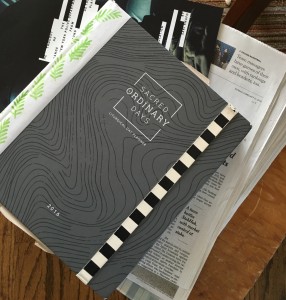
My less-used-than-I'd-like daily planner.
This is my daily planner. It was part of a kick starter campaign and I wanted it. It integrates the church year with the calendar year, and has space for reflection and planning and journaling.
Weeks of it are blank at this point.
But there days here and there that I’ve filled in, and reflection pages that I’ve used. And when I have used it, it’s been monumentally helpful. I’ve made some really important decisions with the help of this planner.
I’m a horrible daily practice person. My current lifestyle exacerbates this. (In the world of child-rearing and keeping house, I’m much more Maria than Captain Von Trapp.) I actually mapped out, in January, what I wish my daily schedule was like. It’s wonderful.
6:00am: run or yoga
6:45am: shower and dress
7:00am: 15 minutes of devotions and previewing the day
7:15-9:00am: the morning rush (getting everyone to school)
9:00am-2:15pm: the tasks of the day
2:15-5:30pm: be present for the kids’ afternoon
5:30-7:00pm: meal and clean up
7:00-8:30pm: bedtimes
8:30-9:00pm: prep for a new day
9:00pm: reset and rest with Erik
But life around here is a moving target, and I can rarely fit this schedule into my day. Here, for example, is how yesterday went.
5:30am: Hazel wakes up
6:30am: Two more kids awake, one with a wet bed.
7:00-8:00am: breakfast and getting people out the door
8:00-8:20am: drop Zora off at school and Erik off at the train
8:20-10:00am: run errands with Abram and Hazel because Abram doesn’t have school and we need some supplies for a project to keep him occupied and we need milk
10:00am-1:15pm: crafts with Abram; making a mess in the kitchen with Abram; make dinner ahead of time; clean up after Abram; feed people lunch
1:15pm-2:35pm: get Abram and Hazel out the door for Abram’s preschool parent teacher conference, drop Abram off at preschool afternoon care, run to the post office
2:35-3:15pm: pick up Abram and Zora, get to Zora’s swimming lesson
4:30-6:30pm: learn that Zora is ready to try out for the swim team, but tryouts don’t happen until 6:30pm and if we don’t try tonight, she has to wait at least a week for another time slot; consult with Erik and ask him to meet us at the train station nearest the swimming facility; take kids out for pizza; meet Erik; play at park
6:30-7:15pm: Zora tries out for swim team
7:45pm: home and get everyone in bed
Yesterday was particularly nuts, but you get the idea.
I’m learning to live with this reality, that I don’t live in a world where everyday is able to fit into the same schedule.
And I figure I’d better extend myself some grace to live in the shape of the days I’ve been given. Which includes some grace for the fact that the blog has been sitting here for over a week.
[ Filed under Lenten Practice 2016 | 0 Comments ]
← Previous Entries
Next Entries →